The brand new discoveries in Pompeii
The ancient city of Pompeii, long entombed by the catastrophic eruption of Mount Vesuvius in AD 79, continues to captivate the world with its remarkable preservation and the stories it tells of Roman life. Recent archaeological endeavors have unearthed a series of extraordinary discoveries, offering fresh insights into the daily lives, social structures, and cultural practices of its inhabitants.
A “Once-in-a-Century” Find: The Private Thermal Complex
In a groundbreaking excavation, archaeologists have unveiled an exceptionally well-preserved private thermal complex, believed to be the largest of its kind ever found in Pompeii. This luxurious bathhouse, part of the estate thought to belong to the affluent politician Aulus Rustius Verus, features a suite of rooms designed for various bathing rituals, including hot, warm, and cold baths, as well as changing rooms adorned with intricate artwork. An adjacent outdoor gymnasium boasts frescoes that have retained their vivid colors over millennia. This discovery not only highlights the opulent lifestyles of Pompeii’s elite but also underscores the stark contrast with the conditions of the slaves who maintained such facilities, evidenced by the immense heating system powered by slave labor.
Revelations Through DNA Analysis
Advancements in DNA analysis have prompted a reevaluation of long-held assumptions about the victims of Vesuvius’s eruption. A recent study involving DNA extraction from 14 individuals has debunked previous theories regarding their identities and relationships. For instance, in the “House of the Golden Bracelet,” a group previously thought to be a family was found to consist solely of males with no close genetic ties. Similarly, two individuals discovered in an embrace, once believed to be female relatives or lovers, were identified as including at least one male. These findings challenge earlier interpretations and highlight the importance of scientific analysis in reconstructing historical narratives.
Artistic Treasures: New Frescoes and a Blue Shrine
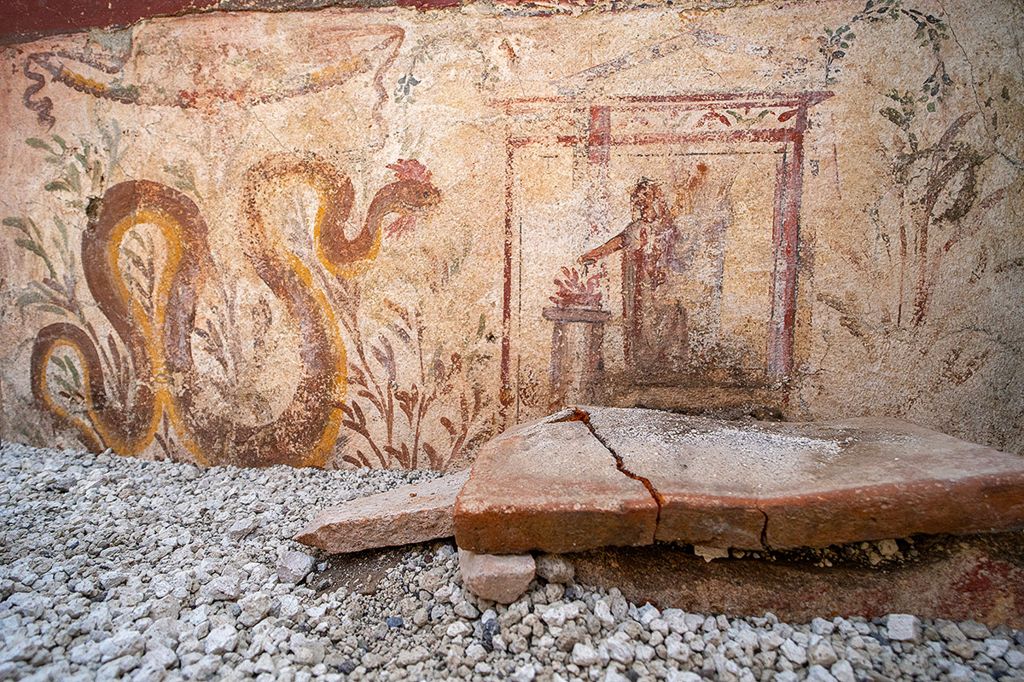
The artistic heritage of Pompeii has been further enriched by the discovery of breathtaking frescoes and a unique blue-painted shrine. In a recently excavated dining hall, frescoes depicting mythological scenes, including portrayals of Helen of Troy and Paris, as well as Apollo and Princess Cassandra, have been uncovered. These artworks offer a glimpse into the aesthetic sensibilities and cultural references of Pompeii’s residents.
Additionally, archaeologists have unearthed an intricately decorated blue room, interpreted as an ancient Roman shrine known as a sacrarium. The walls of this 8-square-meter room are adorned with paintings of female figures believed to represent the four seasons, and the space contained 15 amphorae, two bronze jugs, and two bronze lamps. This rare find provides valuable insights into the religious practices and artistic expressions of the time.
Uncovering Daily Life: A Bakery and Laundry Shop
Further excavations have revealed an entire city block, shedding light on the daily activities of Pompeii’s inhabitants. Among the structures uncovered are a bakery and a laundry shop, complete with well-preserved equipment and facilities. These establishments offer a tangible connection to the routines and labor that characterized everyday life in the ancient city.
Human Stories: The Remains of Two Victims
In a poignant discovery, the remains of two individuals have been found in a small room within the newly excavated area. One skeleton is believed to belong to a man, possibly a slave, while the other is thought to be a woman of higher status. The positioning and context of these remains provide a somber reminder of the human cost of the volcanic disaster and offer insights into the social hierarchies that existed in Pompeii.
Preserving the Past for the Future
These recent discoveries underscore the ongoing importance of archaeological research in Pompeii. Each find adds a new layer to our understanding of this ancient city, illuminating the complexities of Roman society and the lives of its people. As excavations continue, Pompeii remains a vital link to our shared human history, offering lessons and reflections that resonate across the millennia.
The meticulous work of archaeologists not only enriches our knowledge of the past but also ensures that these treasures are preserved for future generations. Through careful excavation, analysis, and conservation, the story of Pompeii continues to unfold, captivating the imagination and deepening our appreciation for the resilience and richness of human culture.